

NLS Waste Power Plant
The plant is targeting 1,300 tonnes per day in incoming fuel. The source of the fuel is predominantly Kampala city where waste is being collected, but also from the surrounding areas of Mukono and Wakiso. This fuel is mostly of organic origin thereby expected to contain a higher moisture level causing the heating value to be around 6.1 MJ/kg. Selective fuel handling with a traditional pre-dryer method are proven ways to use this kind of lower quality fuel in a modern combustion system.
The expected feedstock should allow the plant to produce thermal power of 115 MW. Roughly two- thirds will be produced as steam, and one-third as electricity (equivalent to around 35 MW). However, if a design is selected where the produced heat can be sold to external customers, this will result in electrical production decreasing from approx. 30% to about 25%, but at the same time allowing approx. 60% of the total thermal power produced becoming available as potential income.
A typical Waste to Energy Plant
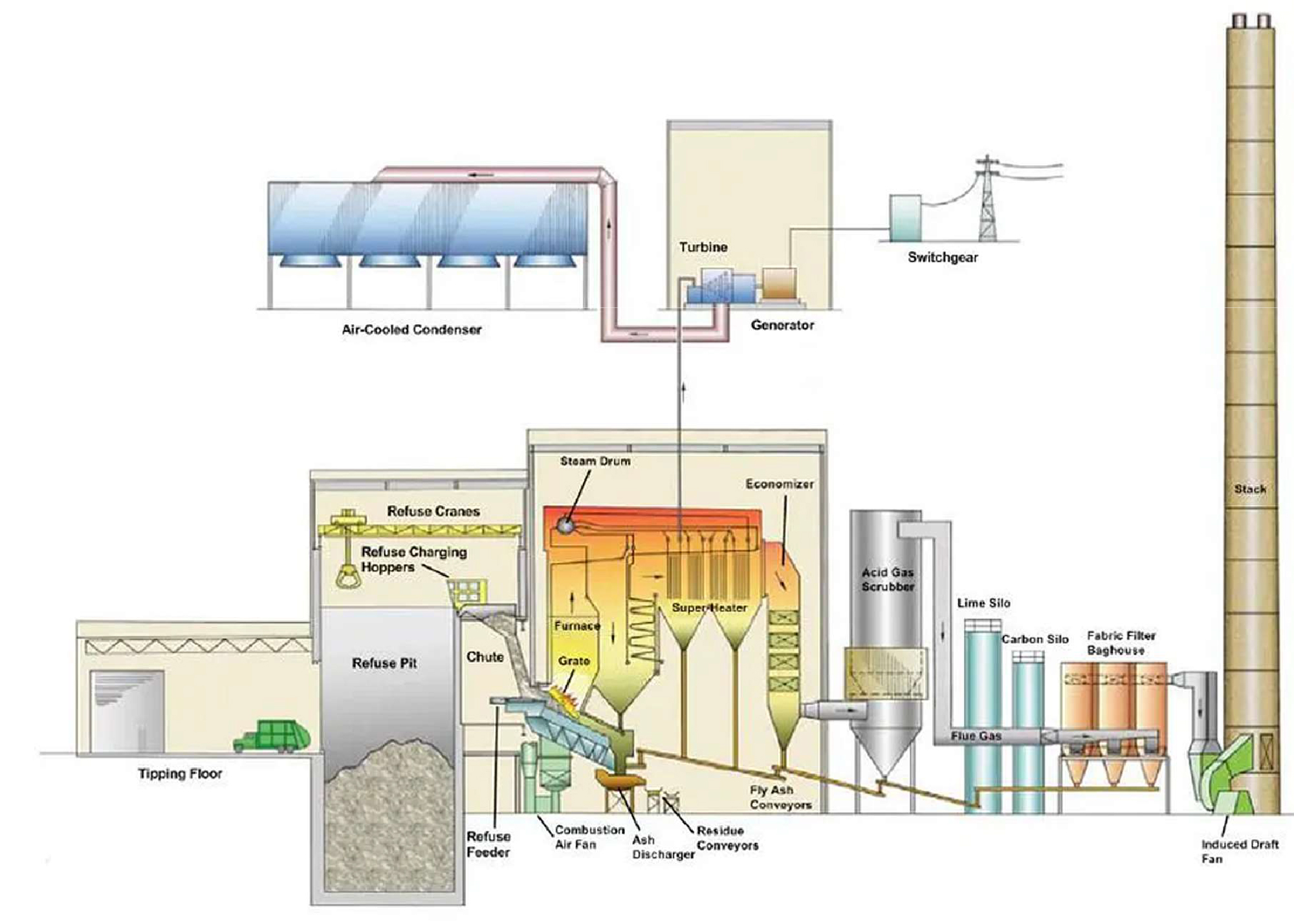
The combustion gases from the plant will be cooled by boiling water to steam and the cooler gases will be treated in a flue gas cleaning stage to ensure good and stable operation with low impact on the environment. The flue gas filtration is recommended to be able to perform in accordance with EU standard emission norms, which are based on best available practice.
The combination of high temperature combustion in a controlled environment with a good flue gas cleaning system has the ability to either destroy or capture the toxic elements of the fuel. The captured material is much more compact and easier to handle than the much larger and slowly decomposing waste that was the initial fuel. The total environmental impact of the waste is significantly reduced, but a controlled destruction compared to a traditional landfill, components such as methane and biphenyls are almost 100% destroyed instead of seeping out from a landfill while heavy metals and chemicals such as dioxins, furans and phthalates are either fully destroyed or captured in the flue gas treatment.